OTT effectiveness can be measured.

Allison Gibson

How often do you ask someone, “What’s a good show you are binge watching right now?” or “I need a good new show to watch?” Probably a lot nowadays. Over the past few years, the rise of OTT (Over-The-Top) services and streaming platforms has transformed the way we consume entertainment and media. With the proliferation of these services, advertisers have also had to adapt their strategies to reach audiences in this new landscape.


OTT services are defined as any video content delivered over the internet and bypassing traditional cable or satellite TV providers. This includes popular streaming platforms like Netflix, Hulu, Amazon Prime Video, Disney+, and many others. These services have become increasingly popular due to their convenience, affordability, and variety of content. According to a report by eMarketer, the number of OTT users in the US is expected to surpass 200 million by 2022.
OTT choices

One of the key advantages of OTT services is that they allow users to watch content on demand, at any time. This means that audiences are no longer tied to traditional TV schedules and can watch their favorite shows or movies whenever they want. As a result, traditional TV advertising has become less effective in reaching audiences, leading advertisers to shift their attention to OTT platforms.


OTT services have also enabled more targeted advertising. Unlike traditional TV ads, which are broadcast to a broad audience, OTT ads can be targeted to specific demographics based on user data such as age, gender, location and behavior. Some examples of targeting options are below:
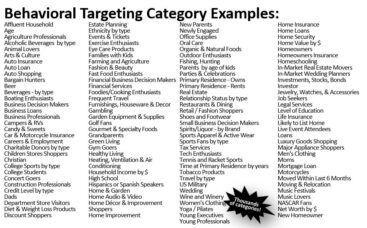
Behavioral targeting category examples

This allows advertisers to deliver more personalized ads that are relevant to their audience, increasing the chances of engagement and conversion.


However, there are still challenges that advertisers face when it comes to OTT advertising. One of the biggest challenges is measuring the effectiveness of OTT ads. Traditional TV advertising relies on metrics such as ratings and impressions, but these metrics may not be as relevant in the OTT landscape. The great news is some measurement is now available for OTT.


The first option is OTT with Visit Tracking. Of the people we serve ads to, we can layer in On-Site Visit Tracking to your business to show you of the people who saw your OTT ad, who then visited your location.


How does this work?

Our OTT behavioral targeting categories are created from first-party data where we have collected mobile device IDS, then we mapped those IDs to a corresponding IP Address. If that IP Address is served an OTT ad on their Connected TV and then that person goes to your client’s location with their mobile device active, it is recorded as an on-site visit.


Talk about great ROI.
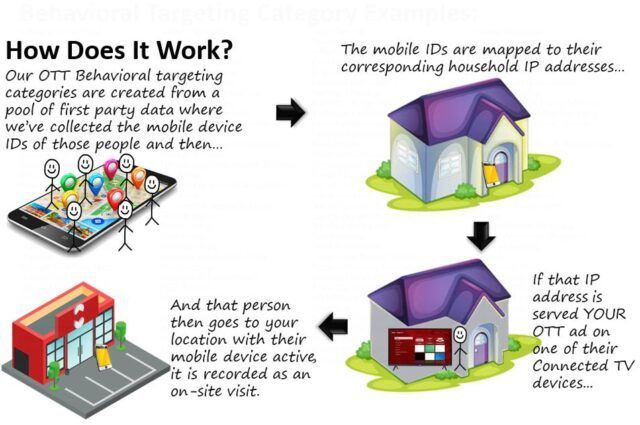
OTT with visits

Another great way to measure ROI is with Social Mirror OTT.


Just like traditional Social Mirror where we can mirror a social post or video, we can also mirror any social video post and create an OTT ad and run it on connected TV’s. The ad features the client’s logo, business name, description and a QR Code. QR Code scans are captured to show that the commercial DID have engagement.
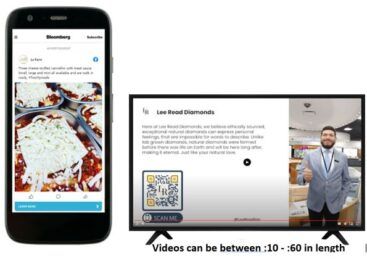
social mirror

So now OTT can be measured for effectiveness outside of traditional metrics like calls, sales or appointments.


The rise of OTT services and streaming platforms has transformed the way we consume entertainment and media, and advertisers have had to adapt their strategies to reach audiences in this new landscape. OTT advertising offers advantages such as targeted advertising with measurable data.


Ready to learn more? Fill out the form below and our team will reach out for a free consultation:

Contact Us

By CCB Media Staff - March 30th, 2026 March 30, 2026
Overview: A well-established building materials supplier wanted to increase brand visibility, engage professional audiences, and drive meaningful online and in-store actions—without relying solely on traditional advertising channels. The goal was to reach contractors, builders, and decision-makers across devices while maintaining efficiency and measurable performance. Digital Strategy: A full-funnel digital advertising approach was deployed, combining high-impact awareness tactics with performance-driven targeting. The campaign leveraged mobile, desktop, and streaming advertising by using advanced B2B behavioral targeting, AI, and retargeting with Social Mirror and CTV, Mobile Conquesting with Geo-Fencing and Geo-Retargeting relevant retail and competitor locations, and QR code-enabled Connected TV ads with Social Mirror to bridge TV exposure with mobile engagement. This multi-channel strategy ensured consistent brand exposure while capturing intent and engagement signals throughout the customer journey. Results: Due to the strong performance and sustained success of the initial campaign, the client has continued running campaigns for more than five years. Over that time, their efforts have generated more than 6,800 total conversions, including 5,400+ verified in-store visits and 2,300+ QR code scans, demonstrating consistent engagement and measurable results across multiple channels.
By CCB Media Staff - March 27, 2026 March 27, 2026
Stop settling for one-off handshakes and expensive paper ads. If you’re paying for a presence at a Home Show or Boat Show , you need a strategy that doesn’t expire when the doors close. Here is how to dominate your next event using Geo-Fencing and Geo-Framing: 1. Build a Digital Fence We "fence" high-traffic events—home shows, boat shows, or conventions. Every mobile phone that enters that zone is captured. While your competitors are handing out flyers, you’re quietly building a high-intent digital audience. 2. The 30-Day Retargeting Blitz The show doesn’t end when the booths come down. We retarget those attendees for 30 days after the event. By showing your ads 10–30 times on their mobile devices, you stay top-of-mind long after the initial handshake. · Pro Tip: Use a specific offer to push urgency and turn "just looking" into a closed sale. 3. Target the Neighborhood (Lookalikes) Since we know where these attendees live, we can target their neighbors . If someone is interested in a home remodel or a new boat, there’s a high statistical chance their neighbors are, too. This "Geo-Retargeting Lookalike" strategy expands your reach to the exact zip codes that matter. 4. Travel Back in Time with Geo-Framing Missed the big regional show last month? No problem. With Geo-Framing , we can pull past data from large-scale events to capture attendees who were there weeks ago. It’s the ultimate "second chance" for your sales team. The Bottom Line: Don’t just sponsor a booklet. Own the digital space and stay in front of qualified prospects before they buy and increase your chances to close the project.
By CCB Media Staff - March 4th, 2026 March 4, 2026
If you’ve noticed your blog traffic dipping lately, you aren’t alone. The traditional "how-to" blog post is losing its punch. Why? Because AI is already answering the question for your customers before they ever click your link. In a world of Generative AI, the old SEO playbook is being rewritten. We are moving from standard SEO into the era of GEO (Generative Engine Optimization). If you want your local business to stay visible in 2026 and beyond, here is exactly what you need to do right now. 1. Audit Your "AI Reputation" Before you change a single word on your website, do this: Open ChatGPT, Gemini, or Perplexity and search for your business. See what the AI says about your business. If it returns incorrect hours, an old address, or misses your key services, you have a data problem. AI models pull from across the web; if they are getting it wrong, it’s because your "digital footprint" is messy. · The Fix: Find the source of the bad info (Yelp, an old directory, or a social profile) and fix it immediately. Ensure your website and Google Business Profile (GBP) have the most current data. 2. Move Beyond "Generic" Content National brands are feeling the AI squeeze most, but local businesses aren't immune. To rank now, your content must be uniquely yours. · Stop writing: "5 Tips for Maintaining Your Roof." (AI can write that in 2 seconds). · Start writing: Case studies of local projects, deep-dives into how our specific climate affects materials, before/after customer stories or client testimonials. · The Rule: If an AI can't replicate the experience, it's worth publishing. 3. Feed the AI "Trust Signals" AI models and search engines are looking for "Proof of Life." They need to know your business is real, active, and trusted. · The "Everything" Strategy: Your website shouldn't just have text. It needs high-quality images, video tours, and a comprehensive "About Us" section. · Seek Awards: Industry awards and "Best of [City]" mentions are huge trust signals for AI. · Maximize Off-Site Profiles: Don't just fill out your Chamber of Commerce or Yellow Pages profile—over-optimize them. Use superlatives (e.g., "The #1 Rated Plumber in Hyannis") and fill out every single available field. 4. Diversify Your Reviews We know that 25% of local search rankings come from your Google Business Profile. While Google reviews are king, AI models look at the whole picture. · Get reviews on Yelp, Facebook, Angi, and industry-specific sites. · AI uses reviews as a primary data source. If customers mention specific services in their reviews ("They fixed my leaking faucet perfectly"), AI learns that you are an expert in that specific service. 5. Get "Hyper-Local" with Reddit and News  Google and ChatGPT currently have a "crush" on Reddit. It represents authentic human conversation—something AI can't fake. · Reddit Strategy: Look for your city’s subreddit (e.g., r/Austin or r/Chicago). Engage naturally. When someone asks for a local recommendation, being mentioned there provides massive SEO and GEO weight. · Local PR: Get mentioned in local news articles or press releases. These high-authority local mentions help AI engines "trust" your business location and authority. The Bottom Line SEO isn't dead; it’s just evolving. By focusing on GEO (Generative Engine Optimization)—feeding AI the right data, diversifying your reviews, and proving your local authority—you’ll stay ahead of the curve while your competitors are still wondering where their traffic went. This story was generated using the AI model ChatGPT-5, with human editing for accuracy and tone.
By CCB Media Staff - February 18, 2026 February 18, 2026
The New Rules of Search: How to Future-Proof Your Local SEO Right Now
By Greg Swiszcz - February 11th, 2026 February 11, 2026
Key takeaways: · Engagement matters before purchase - Attention and interaction are early buying signals. · Relevance beats reach - Personalization cuts through noise. · Confidence drives conversion - Address hesitation at the right moment. · Connected marketing wins - Unified experiences build loyalty. Remember when marketing was simple? You put up a billboard, punched a target demo into some platform, and hoped for the best. Yeah — those days are gone. Today, consumer behavior isn’t just shifting — it’s evolving in ways that make a lot of old playbooks feel downright obsolete. The 2026 Predictions: Consumer Trends Shaping the Marketing Landscape (link to: https://cdn.sanity.io/files/b7pblshe/marketing-prod/d4cac01cc22b6d545997b901f47d2966feba2e80.pdf ) report lays out four big patterns shaping how people engage with brands — and here’s the kicker: these trends aren’t squirreled away in some ivory-tower slide deck. They’re happening now — and the brands that adapt early will own the next wave of customer loyalty and growth. But understanding trends isn’t the same as reaching them. That’s where three modern tools come in: Social Mirror , Mobile Conquesting , and Website Visitor ID — and together they’re a marketer’s playbook for taking trends off the page and into reality. Let’s unpack how this all works — without the jargon and marketing buzzwords.
By CCB Media Staff January 22, 2026
Native Ads – When and Why to Use Them?
By Tracey Geary January 15, 2026
Key Takeaways: · Meta advertising continues to deliver strong ROI for the right brands because it combines unmatched scale, rich first‑party data, and machine‑learning optimization across the full funnel. · Facebook and Instagram are still heavily used by adults with purchasing power—especially parents, homeowners, and decision‑makers—and Meta remains one of the most effective platforms for driving awareness, engagement, and measurable action when paired with the right creative and strategy. You’ve heard it: “Meta doesn’t work anymore.” The reality is more nuanced. Meta still works exceptionally well—but not for everyone, and certainly not in the same way it did in 2018. The brands seeing consistent success on Meta today understand how the platform’s machine learning operates, what types of businesses it is built to serve, and which audiences continue to respond strongly across Meta’s ecosystem. Just as importantly, Meta is far more than “just Facebook.” Meta is the parent company of Facebook, Instagram, Messenger, WhatsApp, and Threads , rebranded to Meta in 2021 to reflect a broader focus on immersive digital experiences and the future of connection. When marketers dismiss Meta, they often overlook the scale, data depth, and intent signals that make it one of the most powerful advertising environments available.
By CCB Media Staff January 6, 2026
How Google AI Impacts Your Local SEO
By CCB Media Staff December 12, 2025
What Is Google Performance Max? Your Guide to Smarter, AI-Powered Advertising
By CCB Media Staff December 3, 2025
Every advertisement begins with an idea or a concept that ultimately requires a solution to bring it to fruition. Time and costs are driving forces in the decision process. Every interaction has the potential to add time and cost to the overall project, making the path to the final product more complex. Controlling as much of the creation process as possible tightens timelines and reduces costs. Having the ability to do graphic design and video editing in-house enables us to elevate the process and direct focus toward the solution rather than additional logistics like meetings and communications. Our Marketing Consultants work directly with our Graphic Designer in real time to convey and perfect the client’s ideas into visual mockups that can quickly be delivered for client review. Changes and edits can be fast-tracked into the project, letting the client review stages in real time. This creates a streamlined and efficient process since the client is part of the ongoing process rather than only seeing a final cut. With this approach we can be nimble and work with a wider variety of clients. Large businesses may have in-house designers that we can work in tandem with, but having our own in-house designer allows us to offer a high level of service to smaller companies who may not have those resources. We pride ourselves on being able to work with local Mom & Pop businesses as well as larger national firms. Consistency is another feature of a close working relation between Marketing, Sales, and Design. As projects move forward, the teams become very familiar with your brand and how to represent it consistently across multiple media from print and digital to video. As the client’s relationship grows with us, we have a track record of representing their brand in a variety of formats.  Coming together as a team to bring a concept to life, lets us put our best efforts and deliver a high-quality product. Having an in-house design team helps keep timelines short and costs down.